
Introduction
When you first step into the world of programming, one name you’ll hear over and over again is Python. Whether it’s web development, data analysis, artificial intelligence, automation, or scientific computing — Python seems to be everywhere.
But what exactly is Python? Why do developers, beginners, and companies all around the world love it so much?
In this post, we’ll break everything down — from Python’s definition to its best features, examples, and the reasons for its massive popularity.
What Is Python?
Python is a high-level, general-purpose programming language that is dynamically typed and garbage collected. It supports multiple programming paradigms and it is often described as a ‘battery-included’ language because of its comprehensive standard library.
Python is an interpreted, object-oriented, open-source programming language with dynamic semantics. It is support modules and packages which encourage modularity and code reuse.
Python is used to build websites and software, automate tasks, and analyze data. It is general-purpose langauge, not specialized for any specific problems, and it can be used to create various programs. Python is also popular for rapid application development.
Python was developed with a strong emphasis on code readability and simple syntax, which allows programmers to express concepts in fewer lines of code.
Python is also known as a ‘glue language’ because it can easily integrate different components of software systems.
Let’s look at a simple Python example:
print('Hello, World!')Output
Hello, World!That’s it! This single line prints Hello, World! to the screen. No semicolons, no complex syntax – just clean and readable code.
Note: Don’t forget to visit the official Python site regularly to stay updated on the latest releases and features.
Key Features of Python
Here are some key features of the Python programming language:
1. High-level Language
A high-level language is a programming language designed to be easier for humans to read, understand, and write. It is closer to natural language and uses commands and instructions that are more abstract and less dependent on the specific details of the underlying computer hardware.
High-level languages enable programmers to write code that is easier to read, maintain, and port across different systems.
Python, Java, C++, and JavaScript are examples of high-level languages. They have syntax and structure that are closer to human-readable language.
2. General-purpose Programming Language (GPL)
A general-purpose programming language (GPL) is a programming language designed for building software across a wide range of application domains. It can be used to solve many different types of problems.
A domain-specific programming language (DSL), on the other hand, is designed for use within a specific domain. For example, Python is a general-purpose language (GPL), whereas SQL is a domain-specific language (DSL).
General-purpose programming languages (GPLs) are usually text-based, meaning programmers write code using textual syntax rather than visual blocks.
3. Dynamically Typed Language
In a dynamically typed language, data type checking takes place at runtime. This means the type of a variable is determined only when the program is executed.
In a statically typed language, the data type of each variable must be known before execution.
4. Garbage-Collected (GC)
Garbage collection is a memory recovery feature built into programming languages. GC-enabled programming languages include one or more garbage collectors (GC engines) that automatically free up memory space that has been allocated to objects no longer needed by the program.
5. Interpreted Language
An interpreted language is one in which the instructions are executed directly by an interpreter, without first being compiled into machine code.
The opposite of an interpreted language is a compiled language. In a compiled language, a program is translated into machine code before execution, allowing the processor to run it directly.
6. Open-source Language
Open-source programming languages are freely available and maintained by a community of developers. Their source code is open to the public, allowing anyone to view, modify, and improve it.
These languages promote collaboration, innovation, and transparency and are often supported by extensive documentation and online communities. Popular examples include Python, Java, PHP, and JavaScript.
7. Batteries Included Language
Python is called a “batteries-included” language because it comes with a comprehensive standard library that provides a wide range of useful modules and packages. These libraries are included by default with every Python installation.
Modules can be imported into programs as needed. Python’s standard library provides modules for tasks such as file handling, data processing, networking, and mathematical or scientific computing.
This “batteries-included” feature makes Python highly useful for promoting code reusability, reliability, and consistency.
Popularity of Python
Python is a widely popular programming language. The following points highlight the reasons for its popularity:
1. Simplicity & Readability
Python’s syntax is often described as simple and intuitive. Unlike many other programming languages, Python code reads almost like plain English, which makes it highly user-friendly.
Python emphasizes clean and readable code. It uses indentation to define code blocks, enhancing readability, and avoids complex syntax.
2. Cross-Platform
Python can run on every operating system, which makes it ideal for every programmer. A Python code written on Windows can run on macOS without any problem. The availability to run on every platform makes Python portable.
Its portability also extends to different hardware architectures, making it possible to use Python in desktop applications, web development, and embedded systems alike.
Furthermore, many popular Python libraries and frameworks are designed to be platform-independent, which allows developers to build applications that work seamlessly across environments.
3. Versatile
Python is a general-purpose programming language, which makes it suitable for a wide range of applications. It is widely used in areas such as web development, data science, and artificial intelligence (AI).
Python is widely used for automation, allowing developers to write scripts that simplify repetitive tasks. It is also employed in game development, as well as in building desktop and mobile applications.
4. Powerful Libraries
Python has a large collection of libraries which includes modules and packages. We can import modules in our program, and we can use the pre-written code. With the help of these libraries, a programmer doesn’t need to write everything from scratch. This can speed up the development.
They cover a wide range of functionality, including web development, data analysis, machine learning, scientific computing, networking, and more.
Python libraries include NumPy for numerical computing, Pandas for data manipulation, Matplotlib for data visualization, TensorFlow and PyTorch for machine learning, and Requests for handling HTTP requests. The availability of these libraries makes Python highly versatile and reduces development time for both beginners and experienced programmers.
5. Large Community & Support
Python is an open-source language that makes it very popular. It has a very large community. These communities have forums, tutorials, documentation, etc. You can share your code with them. You can ask for help. You can also contribute to these communities.
The Python community also organizes conferences, workshops, and local meetups around the world, helping programmers stay up-to-date with the latest developments.
Additionally, community-driven platforms like GitHub, Stack Overflow, and Reddit allow developers to exchange ideas, review code, and collaborate on open-source projects. This strong community support makes Python an accessible and supportive language for both beginners and experienced programmers.
Applications of Python
Python is one of the most versatile programming languages ever created, used across almost every industry. Its simplicity, huge library support, and flexibility make it suitable for everything from web apps to artificial intelligence systems.
Here are some of the most common and powerful applications of Python:
1. Web Development
Python is a popular choice for backend web development because of its robust frameworks that make it easier to create scalable and secure applications.
- Popular frameworks include Django, Flask, and FastAPI.
- Used by well-known platforms like Instagram, Spotify, and Pinterest.
- Ideal for developing dynamic websites and server-side logic.
2. Data Science and Machine Learning
Python dominates the data science field because of its powerful tools and extensive libraries.
- Commonly used libraries: NumPy, Pandas, Matplotlib, Scikit-learn, TensorFlow, and PyTorch.
- Used for data visualization, predictive modeling, AI algorithms, and statistical analysis.
- Data scientists use Python to analyze large datasets, find trends, and train machine learning models.
3. Automation and Scripting
Python can automate almost anything — from simple file operations to complex workflows.
- Automate repetitive office tasks, file renaming, or report generation.
- Use Python scripts to manage emails, handle spreadsheets, or scrape data from websites.
- Tools like Selenium and PyAutoGUI help automate browser and desktop operations.
Example: Writing a script to automatically organize downloaded files into folders.
4. Game Development
Python is also used for developing small and medium-sized games.
- The Pygame library allows developers to create 2D games easily.
- Used for building prototypes, interactive simulations, and educational games.
- Many indie game developers prefer Python because of its ease of use and flexibility.
5. Artificial Intelligence (AI) and Deep Learning
Python is the leading language for AI development due to its simplicity and powerful libraries.
- Libraries like Keras, TensorFlow, and OpenCV are used for deep learning and computer vision.
- Used in speech recognition, image processing, chatbots, and recommendation systems.
- Companies like Google, Amazon, and Netflix use Python in their AI-powered products.
6. Cybersecurity and Ethical Hacking
Python plays a major role in building cybersecurity tools and penetration testing scripts.
- Used for network scanning, vulnerability detection, and automation of security audits.
- Frameworks like Scapy and Paramiko help security professionals analyze networks and servers.
- Many ethical hackers use Python to write scripts that simulate cyberattacks and strengthen security systems.
7. Software Testing and Automation
Python is widely used for testing applications and writing automated test scripts.
- Tools like PyTest, UnitTest, and Selenium make it easy to perform automated software testing.
- It ensures faster bug detection and reduces manual testing time.
8. Internet of Things (IoT)
Python powers many IoT devices due to its compatibility with small hardware and sensors.
- Works seamlessly with Raspberry Pi and MicroPython for embedded system development.
- Used in smart home automation, robotics, and environmental monitoring systems.
9. Desktop Application Development
Python allows you to create simple and powerful desktop apps.
- Frameworks like Tkinter, PyQt, and Kivy are used to design GUI-based applications.
- Examples include calculators, note-taking apps, and small utility software.
10. Finance and FinTech Applications
Python is a go-to language in finance for automating calculations and analyzing market data.
- Used for algorithmic trading, risk analysis, and financial forecasting.
- Libraries like Pandas and NumPy handle large volumes of financial data efficiently.
A Brief History of Python
The story of Python begins in the late 1980s, when Guido van Rossum, a Dutch programmer, started developing a new scripting language to improve upon the shortcomings of the ABC language — a teaching language used at the time. Guido wanted something that was simple, readable, and powerful, yet flexible enough for real-world software development.
He began working on Python during his Christmas holidays in December 1989, and the first official version (Python 0.9.0) was released in February 1991. This version already included many core features that define Python today — such as functions, exceptions, modules, and data types like strings and lists.
Origin of the Name “Python”
Interestingly, the name Python wasn’t inspired by the snake — it came from “Monty Python’s Flying Circus,” a famous British comedy show from the 1970s.
Guido van Rossum, being a big fan of the show, wanted a short, fun, and unique name — something that didn’t sound too serious or technical. That’s how “Python” was born!
Python’s Evolution Over the Years
Python has gone through several major updates, each introducing new features and improvements:
- Python 1.0 (1994):
The first official stable release. It included core features like functions, modules, exceptions, and theprintstatement. - Python 2.0 (2000):
Added new features such as list comprehensions, garbage collection, and Unicode support.
However, Python 2 and Python 3 were not fully compatible, which later led to a long transition period. - Python 3.0 (2008):
Marked a major milestone. It was not backward-compatible with Python 2 but introduced cleaner syntax, improved Unicode handling, and better standard libraries.
Over time, most developers migrated to Python 3. - Python 3.6 – 3.10 (2016–2021):
Introduced many modern features such as f-strings, async/await, and type hinting, which made coding more efficient and expressive. - Python Today (Python 3.12+):
Python continues to evolve with enhanced performance, better memory management, and advanced developer tools. It’s maintained by the Python Software Foundation (PSF) and supported by a massive open-source community.
Python’s history reflects its guiding philosophy — simplicity, readability, and versatility. From its humble beginnings in the 1990s to becoming the world’s go-to programming language, Python continues to evolve while staying true to its roots.
Click here for detailed post on Python history and versions
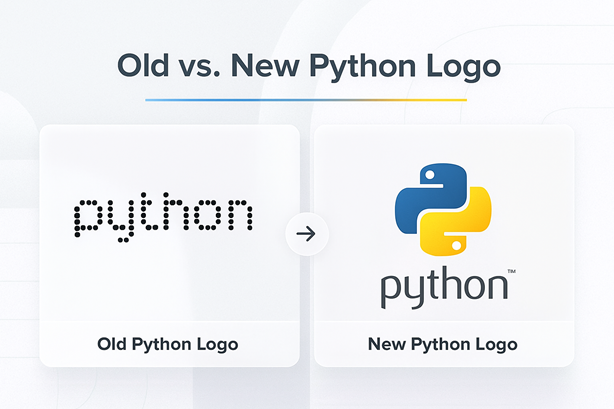
Evolution of the Python Logo
Python’s logo has evolved over the years to better reflect the language’s identity, simplicity, and global recognition. While the core elements have stayed consistent, the design has become more polished and modern.
Old Python Logo (1990s – 2005)
- The earlier Python logos were simple wordmarks or basic graphics without the now-iconic “two-snake” symbol.
- These older designs focused mainly on the text “Python,” often with minimal styling and no unified branding.
- Before the 2000s, there wasn’t a standardized official logo—various communities and documentation used different visual styles.
Modern Python Logo (2005/2006 – Present)
- The current logo features two intertwined snakes (one blue, one yellow) forming a square-like shape.
- Introduced to create a professional and instantly recognizable identity, this logo is now used across all official Python websites and documentation.
- The design symbolizes Python’s simplicity and versatility, with a clean, friendly, and modern look that aligns with the language’s philosophy.
Advantages and Disadvantages
Advantages:
- Simple and beginner-friendly syntax
- Huge community and library support
- Ideal for rapid development
- Portable across platforms
Disadvantages:
- Slower execution speed compared to compiled languages
- Not suitable for mobile app development
- High memory usage for large applications
Example: Simple Python Program
Let’s start with the most basic Python program that every beginner writes — the “Hello, World!” example.
This simple program demonstrates how easy it is to get started with Python.
1. The Classic “Hello, World!” Example
# This program prints "Hello, World!" to the screen
print("Hello, World!")
Explanation:
- The line starting with
#is a comment. Comments are ignored by Python and are used to describe what the code does. - The
print()function displays text or data on the screen. - Everything written inside the parentheses and quotes (
" ") is printed as it is.
Output:
Hello World!This small example shows how Python focuses on simplicity — no need for complex syntax or setup. You can run this code directly in the Python interpreter or any code editor.
2. Python Program to Add Two Numbers
Here’s another simple example to show how Python handles variables and basic arithmetic.
# Program to add two numbers
num1 = 5
num2 = 7

sum = num1 + num2
print("The sum is:", sum)
Explanation:
- We create two variables
num1andnum2and assign them values. - The
+operator adds them together. - The
print()function displays the result.
Output:
The sum is: 123. Using Input from the User
Python also allows you to take input directly from the user using the input() function.
# Program to take user input
name = input("Enter your name: ")
print("Hello,", name, "Welcome to Python!")
Explanation:
- The
input()function reads text entered by the user. - The entered value is stored in the variable
name. - We then display a personalized greeting using
print().
Output:
Enter your name: PyCoder
Hello, PyCoder Welcome to Python!
4. Conditional Statement Example
Python’s syntax makes it easy to work with conditional statements.
# Check if a number is positive or negative
num = int(input("Enter a number: "))

if num > 0:
    print("The number is positive.")
elif num == 0:
    print("The number is zero.")
else:
    print("The number is negative.")
Explanation:
- The
if,elif, andelsestatements control the program flow based on conditions. - The
int()function converts user input (which is text by default) into an integer. - The code checks the number and prints the correct result.
Output:
Enter a number: -5
The number is negative.
5. Python Loop Example
Loops in Python are simple and expressive. Here’s an example using a for loop.
# Program to print numbers from 1 to 5
for i in range(1, 6):
    print(i)
Explanation:
- The
range(1, 6)function generates numbers from 1 to 5. - The
forloop goes through each number and prints it.
Output:
1
2
3
4
5
These small programs demonstrate:
- Python’s clean and readable syntax
- How easy it is to perform basic input/output operations
- The simplicity of control flow (like
ifstatements and loops) - Why Python is ideal for beginners who want to see results quickly
Python lets you start writing real code from day one — no long setup, no complex structure, and no confusing syntax.
Conclusion
Python has proven itself to be far more than just a beginner-friendly language — it’s a powerful tool that drives modern technology. From web development and automation to artificial intelligence and data science, Python continues to shape the digital world around us.
If you’re just starting your programming journey, Python is the perfect place to begin. It’s simple enough to learn quickly, yet powerful enough to build complex applications once you master the basics.
So open your code editor, run your first “Hello, World!” program, and take your first step into the world of Python programming. The possibilities with Python are truly endless!
Next Post
Python Introduction: The Evolution of Python and Its Major Versions Explained
Suggested Posts
1. Python Introduction: The Evolution of Python and Its Major Versions Explained
2. Python Introduction: Installing Python, Setting Up PyCharm, and Writing Your First Program
3. Python Introduction: What Does Dynamically Typed Mean in Python?
4. Python Introduction: Strong vs. Weak Typing Explained
5. Python Introduction: What Is IDLE and How to Write and Run Python Code
6. Python Introduction FAQ: Answers to the Most Common Questions for Beginners


6 thoughts on “Python Introduction: What Is Python, Its Features, and Why It’s So Popular”