
Previous Post
Python Introduction: What Is Python, Its Features, and Why It’s So Popular
Introduction
Python is one of the most influential programming languages of the modern era — simple, readable, and incredibly versatile. But its journey to the top didn’t happen overnight. Python’s story is one of innovation, community, and constant evolution — from a humble scripting idea in the 1980s to a language powering artificial intelligence, web servers, data analysis, and more.
In this detailed post, we’ll explore the entire history of Python, including:
- How and why Python was created
- Major version milestones
- Features added (and removed) in each version
- Key differences between Python 2 and 3
- The role of PEPs, guiding principles, and Python’s influence on modern programming
The Birth of Python
Starting
- Creator: Guido van Rossum
- Year: 1989
- Place: CWI (Centrum Wiskunde & Informatica), Netherlands
- Inspiration: ABC language (a teaching language at CWI), with a focus on readability and simplicity
- Why “Python”?: Named after the British comedy group Monty Python, not the snake!
Python’s story begins in the late 1980s in the Netherlands. Guido van Rossum, a researcher at the Centrum Wiskunde & Informatica (CWI), was working on the ABC language and needed a hobby project to keep him busy during the Christmas break of 1989. He wanted to build a language that was:
- Easy to read and write
- Powerful enough for system tasks
- A balance between C and shell scripting
“I wanted to create an interpreted language that would appeal to Unix/C hackers.” — Guido van Rossum
The Name
Contrary to popular belief, Python is not named after the snake. Guido was a fan of the British comedy troupe Monty Python’s Flying Circus and named the language in their honor. This is why you often find references to “spam,” “eggs,” and Monty Python sketches in official documentation and tutorials.
The first official release, Python 0.9.0, came in February 1991. It already included exception handling, functions, and the core data types we know and love: list, dict, str, and more. However, it lacked a garbage collector (this came later in 1.0).
The Languages That Inspired Python
Before Python, Guido had worked on the ABC language, which greatly influenced Python’s simplicity and design.
Here’s a quick look at Python’s main influences:
| Language | Contribution to Python |
|---|---|
| ABC | Readability, simplicity, high-level data structures |
| C | Performance, structure, and extensibility |
| Modula-3 | Modularity and exception handling |
| Unix Shell | Interactivity and scripting approach |
Example:
# Python code inspired by ABC-style simplicity
numbers = [1, 2, 3, 4]
squares = [n**2 for n in numbers]
print(squares)
The Zen of Python: Guiding Principles
Python’s philosophy can be summarized in the “Zen of Python,” written by Tim Peters.
Type this in your interpreter:
import thisOutput:
The Zen of Python, by Tim Peters

Beautiful is better than ugly.
Explicit is better than implicit.
Simple is better than complex.
Complex is better than complicated.
Flat is better than nested.
Sparse is better than dense.
Readability counts.
Special cases aren't special enough to break the rules.
Although practicality beats purity.
Errors should never pass silently.
Unless explicitly silenced.
In the face of ambiguity, refuse the temptation to guess.
There should be one-- and preferably only one --obvious way to do it.
Although that way may not be obvious at first unless you're Dutch.
Now is better than never.
Although never is often better than *right* now.
If the implementation is hard to explain, it's a bad idea.
If the implementation is easy to explain, it may be a good idea.
Namespaces are one honking great idea -- let's do more of those!
You can see 19 principles that define Python’s design. Most famous ones are:
- Beautiful is better than ugly.
- Simple is better than complex.
- Readability counts.
- Errors should never pass silently.
These principles influenced every version of Python — making it elegant, maintainable, and human-friendly.
The Early Years: Python 0.x (1991–1994)
Python 0.9.0 (February 1991)
Python’s first public release included:
- Core data types:
str,list,dict - Exception handling
- Functions and modules
- Basic I/O and flow control
Example from Python 0.9.0:
def greet(name):
    print("Hello", name)

greet("World")
Python’s syntax was already clean, indentation-based, and close to today’s version.
The 1.x Era (1994–2000): Foundation and Growth
Python 1.0 (January 1994)
This was Python’s first stable release. Major Additions:
• lambda, map(), filter(), reduce()
• Exception handling improvements
• Modular programming support
Example – Lambda and Map:
numbers = [1, 2, 3, 4]
squares = list(map(lambda x: x ** 2, numbers))
print(squares)
Python 1.4 (1996)
- Introduced keyword arguments (e.g.,
func(name='Alice')) for clearer and more flexible function calls. - Added built-in support for complex numbers (e.g.,
3 + 4j), enhancing mathematical and scientific computing capabilities. - Introduced the
picklemodule for object serialization and persistence. - Improved exception handling mechanisms for more robust error control.
Python 1.5 (1997)
- Introduced DOM support
- Strengthened module and package system
- The standard library began expanding rapidly
The 2.x Era (2000–2010): The Transitional Decade
Python 2.0 (October 2000)
This version introduced features that shaped the modern Python era.
Key Features:
• List comprehensions
• Garbage collection
• Unicode support
• Iterators
Example – List Comprehensions:
squares = [x ** 2 for x in range(10)]
print(squares)
Python 2.2 (Dec 2001)
• Introduced new-style classes, unifying classic classes and built-in types under a single object model (all classes now inherit from object).
• Added iterators and generators (via the yield keyword), improving memory efficiency and making it easier to work with large datasets or streams.
• Introduced zip(), enumerate(), and other modern built-in functions.
• Added the __slots__ feature to control instance attribute creation and optimize memory usage.
• Improved type/class unification, allowing built-in types (like int, list, etc.) to behave more like user-defined classes.
Python 2.5 (Sep 2006)
• Introduced the with statement (context managers) for cleaner resource management (e.g., with open('file.txt') as f:).
• Added try / except / finally unified syntax for better exception handling.
• Introduced the @contextmanager decorator in the contextlib module to easily create custom context managers.
• Added any() and all() built-in functions for concise logical evaluations.
Python 2.7 (2010)
The final major release of Python 2.x.
It served as a bridge to Python 3, with several modern features backported.
Backported Features:
• Dictionary comprehensions
• with statement
• print() function compatibility
Example – Dict Comprehensions:
squares = {x: x**2 for x in range(5)}
print(squares)
Support for Python 2 officially ended on January 1, 2020, marking a new era.
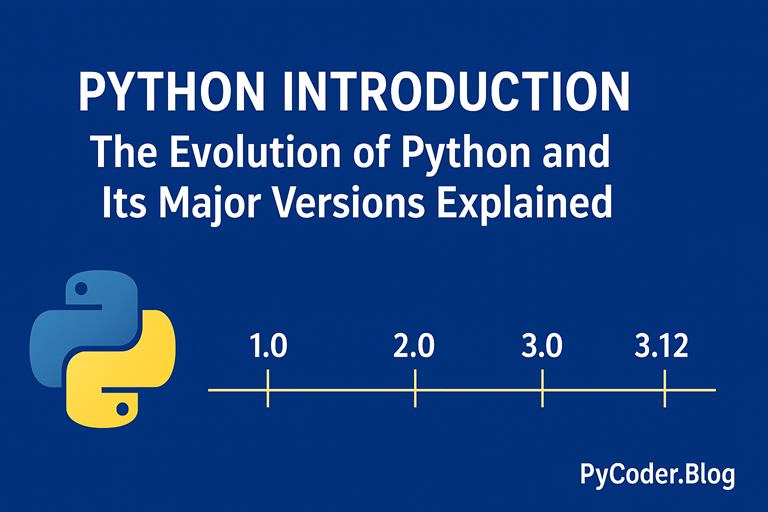
The 3.x Era (2008–Present): The Modern Python
Python 3.0 (December 2008)
Also known as “Python 3000” or “Py3k,” this was a backwards-incompatible release. Its goal was to rectify fundamental design flaws and redundancies that had accumulated in Python 2. It was not an update but a new beginning.
Major Changes:
printbecame a function →print("Hello")- Unicode by default
- Removed outdated syntax like
<> - Integer division now returns float (
5/2 = 2.5) - Clear distinction between
bytesandstr
Example:
print("Python 3 says hello!")Python 3.3 (September 2012)
• Introduced the venv module for creating lightweight virtual environments.
• Added the yield from expression to simplify generator delegation.
• Introduced the __qualname__ attribute for better function and class name tracking.
• Implemented a new filesystem encoding strategy, improving cross-platform file handling.
• Added the faulthandler module to help debug crashes and low-level errors.
Python 3.5 (Sep 2015)
• Introduced the async and await syntax for native asynchronous programming.
• Added the @ operator for matrix multiplication (used by NumPy and similar libraries).
• Introduced type hinting via the typing module for better code clarity and tooling support.
• Added unpacking generalizations, allowing syntax like {**dict1, **dict2} and [*list1, *list2].
• Introduced the pathlib module as a modern, object-oriented way to handle filesystem paths.
Python 3.6 (Dec 2016)
• Introduced f-strings (f"Hello, {name}") for fast and readable string formatting.
• Added underscores in numeric literals for better readability (e.g., 1_000_000).
• Introduced asynchronous comprehensions and async generators.
• Implemented a new dictionary implementation (insertion-ordered and more memory-efficient).
• Added the secrets module for generating cryptographically secure random numbers.
Python 3.8 (Oct 2019)
• Introduced the walrus operator (:=) for assignment expressions within expressions.
• Added positional-only parameters in function definitions using the / syntax.
• Introduced the f"{expr=}" debug-friendly f-string feature to show both expression and value.
• Added the math.prod(), statistics.fmean(), and other new math/statistics utilities.
• Improved performance and debugging with better traceback information and interpreter optimizations.
Python 3.9 (Oct 2020)
• Introduced dictionary merge (|) and update (|=) operators for easier dict handling.
• Added type hinting generics in standard collections (e.g., list[int] instead of List[int]).
• Improved string methods with new functions like removeprefix() and removesuffix().
• Enhanced timezone support via the new zoneinfo module.
• Included multiple performance and parser improvements, featuring a brand-new PEG parser.
Python 3.10 (Oct 2021)
• Introduced structural pattern matching (match / case statements), similar to switch-case logic.
• Added parenthesized context managers for cleaner multi-line with statements.
• Improved error messages with more precise and readable syntax hints.
• Enhanced type hinting with union types using the | operator (e.g., int | str).
• Various performance boosts and standard library refinements.
Python 3.11 (Oct 2022)
• Delivered significant performance improvements — up to 10–60% faster execution.
• Introduced ExceptionGroup and except* for handling multiple exceptions concurrently.
• Enhanced error tracebacks with more precise and detailed location information.
• Improved typing system with features like Self, LiteralString, and Required/NotRequired.
Python 3.12 (October 2023)
• Introduced major speed and memory optimizations, making Python faster and leaner.
• Improved typing system with features like TypeVarTuple and refined type annotations.
• Enhanced f-string syntax, allowing more flexible expressions and debugging.
• Continued standard library cleanup — removing deprecated modules and improving consistency.
Python 3.13 (October 2024)
• Introduced experimental Free-threaded CPython, allowing true multi-threaded performance without the Global Interpreter Lock (GIL).
• Added an official interactive REPL improvement with syntax highlighting and better error hints.
• Enhanced typing system with new annotations and stricter type checking support.
• Improved startup speed and memory usage, continuing the performance optimization trend.
• Expanded standard library cleanup and modernization, removing more legacy modules.
Python 3.14 (October 2025)
• Official support for a free-threaded build, making it possible to use Python without the GIL in supported configurations.
• Deferred evaluation of annotations, meaning type annotations are evaluated only when needed, improving forward-reference handling and performance.
• Introduced template string literals (t-strings) for more flexible and customizable string templating.
• Added support for multiple interpreters in the standard library, enabling “sub-interpreter” usage in a more official manner.
• Enhanced the interactive experience (REPL) with syntax-highlighting, improved error messages, and tooling enhancements.
Timeline of Python’s Evolution
| Year | Version | Major Milestone |
|---|---|---|
| 1989 | — | Guido begins development |
| 1991 | 0.9.0 | First public release |
| 1994 | 1.0 | First stable version |
| 2000 | 2.0 | Unicode, garbage collection |
| 2008 | 3.0 | Modernized syntax and semantics |
| 2010 | 2.7 | Final Python 2 version |
| 2018 | 3.7 | Dataclasses, async improvements |
| 2020 | 3.9 | Dict merge, improved typing |
| 2021 | 3.10 | Pattern matching |
| 2022 | 3.11 | 60% faster performance |
| 2023 | 3.12 | Typing and speed refinements |
| 2024 | 3.13 | Faster, smarter typing, and improved performance. |
| 2025 | 3.14 | Performance boosts, runtime improvements, and continued enhancements to typing and error handling |
The Role of PEPs (Python Enhancement Proposals)
Python’s evolution is governed by PEPs — community-submitted documents proposing improvements.
Notable PEPs:
- PEP 8: Style Guide for Python Code
- PEP 20: The Zen of Python
- PEP 484: Type Hinting
- PEP 572: Walrus Operator (
:=) - PEP 618:
zip()strict mode
Example – Type Hints (PEP 484):
def greet(name: str) -> str:
    return f"Hello, {name}"
Features Added and Removed Over Time (Quick Overview)
Python 1.x Series
- Added: Keyword arguments, complex numbers,
picklemodule (v1.4). - Goal: Core language foundation, basic OOP, and math capabilities.
Python 2.x Series
- 2.0 (2000): Introduced list comprehensions, garbage collection, Unicode support.
- 2.2 (2001): Added new-style classes, iterators, generators, and descriptors.
- 2.5 (2006): Added
withstatement,ctypes, andany()/all()functions. - Removed: Little removals — Python 2.x remained mostly backward-compatible.
- Goal: Improved OOP and readability; built groundwork for Python 3.
Python 3.0 (2008) — The Big Break
- Added: Unicode by default,
print()as a function, clearer integer division, bytes vs. str separation. - Removed: Outdated syntax like
<>, old-style classes, and implicit string conversions. - Goal: Language cleanup and modernization (breaking compatibility).
Python 3.3–3.6 (2012–2016)
- 3.3: Added
venv,yield from, and better filesystem encoding. - 3.5: Introduced
async/await,typing, and@matrix operator. - 3.6: Added f-strings, underscores in numbers, and async generators.
- Goal: Modern syntax, readability, and async programming support.
Python 3.7–3.9 (2018–2020)
- 3.7: Added data classes, context vars, and
breakpoint(). - 3.8: Added the walrus operator (
:=) and positional-only parameters. - 3.9: Added dict merge (
|) operators, new string methods, andzoneinfo. - Goal: Cleaner syntax, developer productivity, and time zone support.
Python 3.10–3.12 (2021–2023)
- 3.10: Introduced structural pattern matching (
match/case), union types with|. - 3.11: Major speed boost,
ExceptionGroup, and better error tracebacks. - 3.12: Enhanced f-string syntax, faster startup, and typing refinements.
- Removed: Deprecated standard modules and outdated APIs.
- Goal: Performance, clarity, and typing maturity.
Python 3.13 (2024)
- Added: Experimental free-threaded CPython (no GIL), improved REPL, and typing updates.
- Goal: True multithreading and developer experience improvements.
Python 3.14 (2025)
- Added: Official free-threaded build, t-strings (template string literals), deferred annotation evaluation, and multi-interpreter support.
- Goal: Safer templating, modern concurrency, and deeper runtime control.
Detailed Comparison: Python 2 vs Python 3
| Feature | Python 2 | Python 3 |
|---|---|---|
print "Hello" | print("Hello") | |
| Division | 5/2 = 2 | 5/2 = 2.5 |
| Unicode | Optional | Default |
| Input | raw_input() | input() |
| Iterators | Lists returned | Lazy iterators |
| Error Handling | except Exception, e: | except Exception as e: |
| End of Life | 2020 | Active |
Code Example:
# Python 2
print "Sum:", 5 / 2

# Python 3
print("Sum:", 5 / 2)
Output:
Python 2 → Sum: 2
Python 3 → Sum: 2.5
Conclusion
Python’s history is a remarkable journey of evolution, driven by a vision for simplicity and readability. From Guido van Rossum’s first prototype in 1989 to the modern 3.x releases, Python has continually adapted to new technologies while staying true to its core philosophy — making programming intuitive, expressive, and enjoyable for everyone. Each version has introduced innovations that improved the language’s power, consistency, and user experience.
Today, Python stands as one of the most versatile languages in the world, powering applications in web development, data science, AI, and automation. Its story reflects more than just version updates — it’s the story of a language shaped by community, guided by clarity, and strengthened by decades of thoughtful improvement.
Next Post
Python Introduction: Installing Python, Setting Up PyCharm, and Writing Your First Program
Suggested Posts
1. Python Introduction: What Is Python, Its Features, and Why It’s So Popular
2. Python Introduction: Installing Python, Setting Up PyCharm, and Writing Your First Program
3. Python Introduction: What Does Dynamically Typed Mean in Python?
4. Python Introduction: Strong vs. Weak Typing Explained
5. Python Introduction: What Is IDLE and How to Write and Run Python Code
6. Python Introduction FAQ: Answers to the Most Common Questions for Beginners

6 thoughts on “Python Introduction: The Evolution of Python and Its Major Versions Explained”